Project Overview
Debre Tsion Mekane Yesus Church is a growing congregation located in Addis Ababa, with three additional fellowship branches in Sululta, Burayu, and Sebeta. The church serves approximately 3,800 active members across four weekly services (two in Amharic, one in English, one in Afan Oromo) plus 25 small group fellowships (Mahibere Hawariat). Before ETChurch, member data was kept in handwritten ledgers and scattered Excel files. Tithe and offering tracking relied on manual counting and paper receipts, making it difficult to provide annual contribution statements to members.
Church administrators spent over 20 hours per week on administrative tasks instead of ministry work. Tracking attendance across multiple services and branches was nearly impossible, and small group leaders had no way to report attendance or prayer requests systematically.
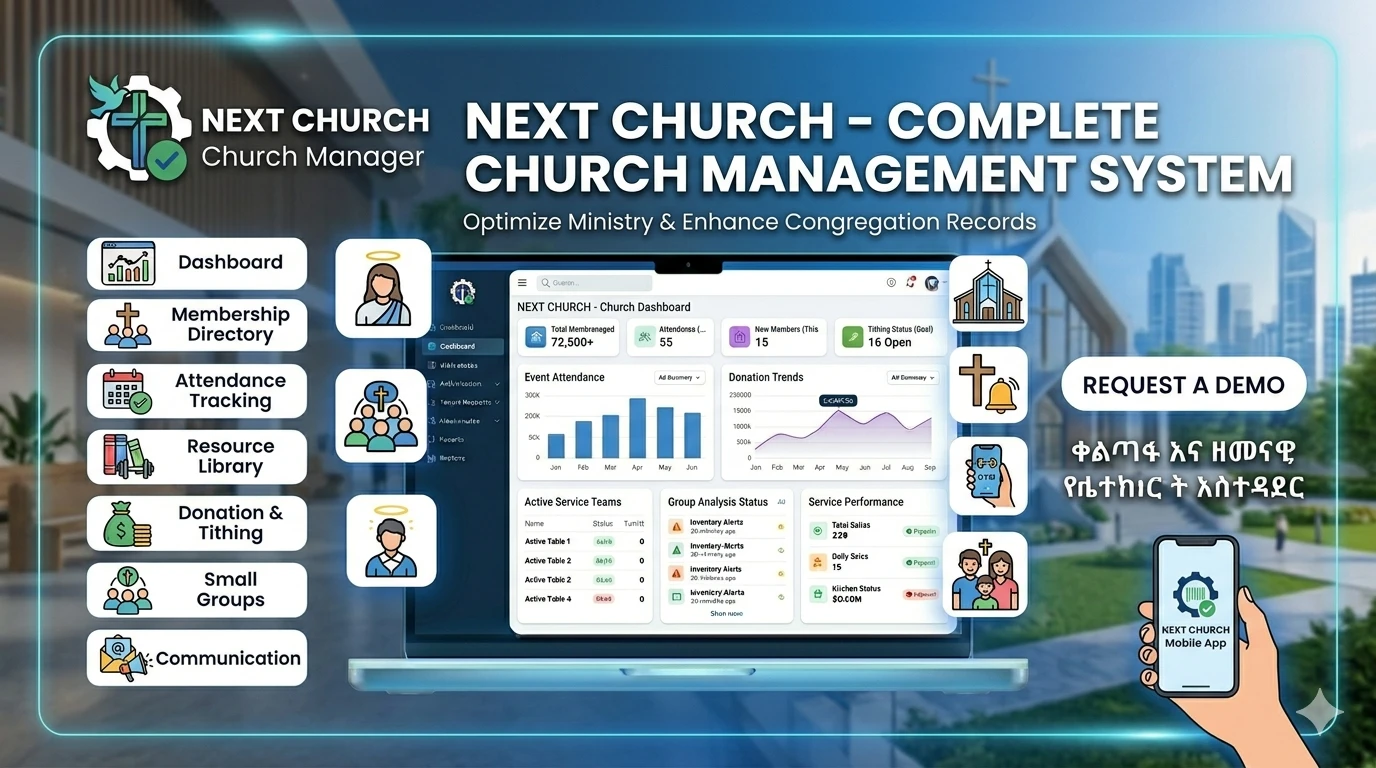
ETChurch was developed as an all-in-one, cloud-based but offline-capable church management system tailored specifically for Ethiopian church contexts. Key features include:
-
Member profile management with baptism records, marital status, fellowship groups, and service preferences
-
Tithe and offering tracking with anonymous giving options, pledge management, and printable annual contribution statements (for Ethiopian tax-exempt donation receipts)
-
Attendance tracking across multiple services, branches, and special events
-
Small group (Mahibere / Shemis) management with leader dashboards, attendance, and prayer request tracking
-
Event management for holy day celebrations, weddings, funerals, baptisms, and conferences
-
Volunteer scheduling for ushers, choir, Sunday school teachers, and hospitality teams
-
Financial accounting tailored for Ethiopian church income/expense categories (tithe, offertory, development fund, missionary support)
-
Multi-language interface (Amharic, English, Afan Oromo)
-
Offline mode for branches with unstable internet
-
SMS and Telegram integration for church announcements (popular in Ethiopian context)
The Challenge of Project
The project faced five major challenges specific to Ethiopian church operations:
1. Diverse Denominational Practices
Different Ethiopian church traditions handle membership, giving, and holy days differently. Orthodox churches track baptism sponsors (Godparents/Yeweseb) and have complex holy day cycles. Evangelical churches emphasize small groups and offerings. The system had to be configurable enough to serve multiple denominations while remaining simple for local administrators.
2. Low Digital Literacy Among Church Leaders
Many church elders and committee members (ages 50+) had never used a computer or smartphone for church administration. Training had to be delivered in Amharic with extremely simple interfaces. Some rural fellowship leaders accessed the system via basic Android phones, requiring an SMS-based check-in option.
3. Financial Transparency and Trust
In Ethiopian churches, handling tithes and offerings requires absolute transparency. Multiple counters from different church committees must verify amounts independently. The system needed to support dual verification (two-person counting) and generate printed reports that can be presented to the general congregation during monthly church meetings.
4. Offline and Low-Bandwidth Operation
The Sululta and Sebeta branches experienced frequent power cuts and poor network coverage. A fully cloud-based system would fail regularly. ETChurch needed offline-first architecture where data syncs when connectivity returns. Sunday offering data entered offline must never be lost.
5. Holy Day Calendar Complexity
Ethiopian church holy days follow the ancient calendar system with moving dates. Fasika (Easter) and Timket (Epiphany) dates differ from Western calculations. The system required a built-in Ethiopian calendar converter and automated event scheduling for recurring holy days.
Final Results
After full deployment across all four locations and a 10-week training and transition period, ETChurch delivered the following measurable results:
Metric Before ETChurch After ETChurch (14 weeks)
Administrative hours spent weekly 20+ hours 5 hours Member data completeness (%) 42% 91% Offering counting & reporting time 4 hours (Sundays) 45 minutes Small group attendance reporting rate 35% 88% Time to generate annual contribution statements 3 weeks (manual) 10 minutes Duplicate member records ~250 Less than 10
Additional outcomes:
-
Increased giving transparency: Members can now request and receive contribution statements for tax purposes. Anonymous giving increased by 18% after privacy controls were explained.
-
Better pastoral care: Attendance drop-off alerts help pastors identify members who have missed three consecutive services. The church reached out to 65 inactive members, with 28 returning to regular attendance.
-
Holy day planning: The 2026 Timket and Fasika events had double the volunteer sign-ups compared to previous years using the automated scheduling feature.
-
Financial audit success: The church passed its first internal financial audit with zero discrepancies in offering records, a first in its 15-year history.
-
Rural branch inclusion: The Sululta branch, operating mostly offline, successfully entered offering data every Sunday for 10 weeks. Data syncs when deacons travel to Addis Ababa weekly, with zero data loss.
-
Telegram integration: Weekly announcements via Telegram reached 1,800+ subscribed members, increasing attendance for midweek prayer meetings by 34%.
Member satisfaction: A survey of 200 members showed 89% found the digital contribution receipt system trustworthy. Small group leaders reported spending less time on paperwork and more time on discipleship.
The system is now being considered by three additional Ethiopian churches (two in Addis Ababa, one in Gondar) for adoption. An Amharic user manual and video tutorials were produced as part of the sustainability plan.