Project Overview
Habesha Trading PLC is a wholesale distributor of electronics, home appliances, and construction materials operating in Addis Ababa, with secondary warehouses in Adama and Bahir Dar. The company manages over 3,500 SKUs across three locations, serving 200+ retail customers and 50+ institutional buyers. Before iSTOCK, inventory was managed using a combination of Excel spreadsheets and a slow, on‑premise desktop application that could not synchronize across warehouses.
This led to frequent stock discrepancies, overstocking of slow‑moving items, stockouts of high‑demand products, and difficulty tracking expiry dates for items like batteries and adhesive materials. Manual reconciliation during month‑end closing took the finance team over 10 days.
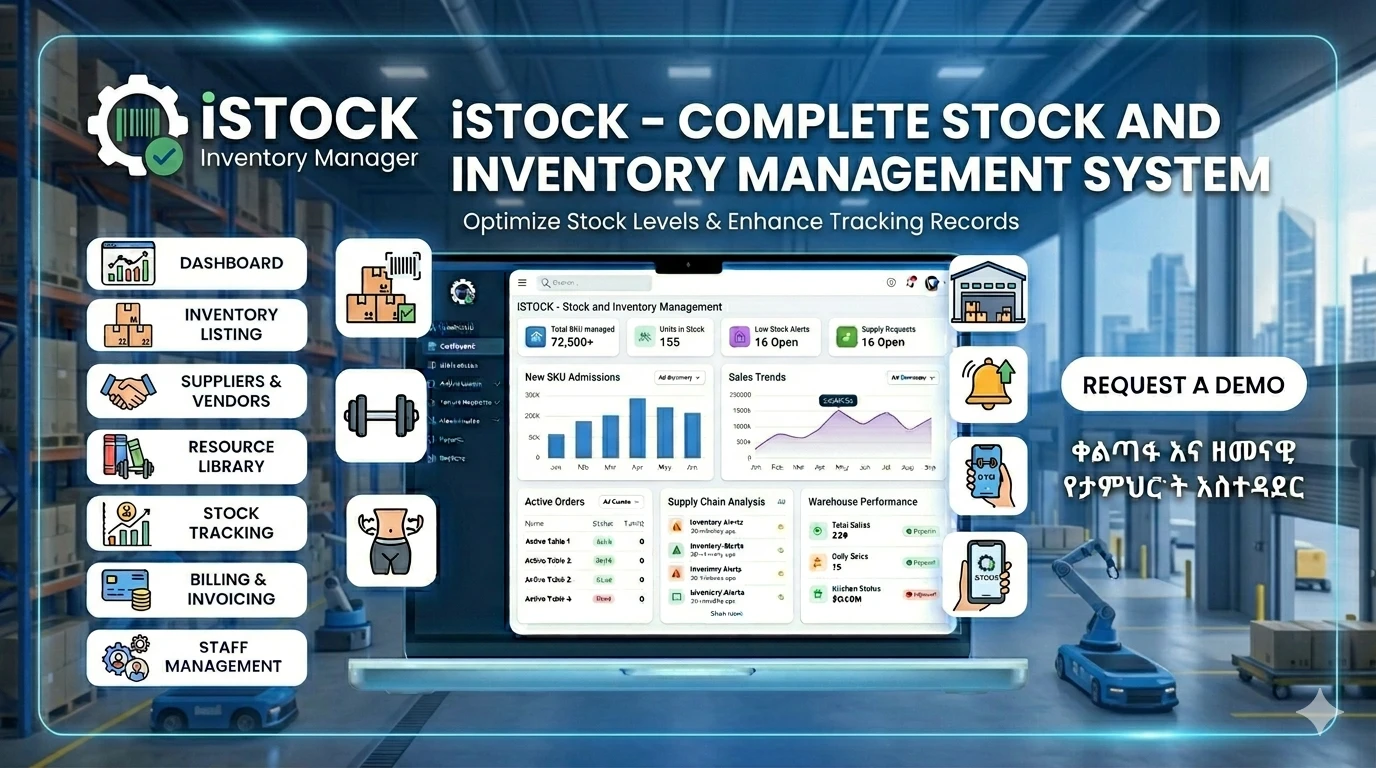
iSTOCK was developed as a cloud‑first but offline‑capable inventory system tailored for Ethiopian business realities. Key features include:
-
Real‑time stock levels across all warehouses with transfer management
-
Barcode and QR code scanning for fast check‑in/check‑out
-
Expiry and batch tracking for time‑sensitive goods
-
Automated reorder points with purchase order generation
-
Supplier portal for order confirmation and invoice submission
-
Ethiopian tax integration (VAT, TOT, withholding tax, sales ledger)
-
Offline mode for areas with unreliable internet (syncs when reconnected)
-
Multi‑currency purchase support (ETB, USD, CNY) with real‑time exchange rate logging
The Challenge of Project
The project faced four major challenges specific to the Ethiopian market and Habesha Trading's operations:
1. Unreliable Internet Connectivity
Warehouses in Adama and Bahir Dar experienced frequent power outages and unstable 4G/LTE coverage. Any cloud‑only system would become unusable for hours or days. The solution required an offline‑first architecture where staff could continue scanning, receiving, and dispatching stock locally, with automatic synchronization once connectivity was restored.
2. Complex Tax and Regulatory Compliance
Ethiopian tax authorities require detailed inventory‑linked reporting including VAT on sales and purchases, TOT (Turnover Tax) for non‑VAT registered customers, and withholding tax certificates from suppliers. The system had to generate reports in a format accepted by the Ministry of Revenues and integrate with the upcoming electronic invoicing (e‑invoice) mandate.
3. Multi‑Warehouse Data Inconsistency
Before iSTOCK, each warehouse maintained separate Excel files. Stock transfers between Addis Ababa and regional warehouses took 3–5 days to reflect in all records, leading to sales staff promising stock that was already allocated or in transit. A centralized but offline‑capable database with last‑write‑win conflict resolution was needed.
4. User Resistance and Low Digital Literacy
Warehouse staff in Bahir Dar had limited experience with digital inventory systems. Many were accustomed to paper‑based receiving logs. Training had to be conducted in Amharic (local language) with simple, icon‑driven interfaces. Barcode scanning was chosen over manual search to reduce data entry errors.
Final Results
After full deployment across all three warehouses and an 8‑week stabilization and training period, iSTOCK delivered the following measurable results:
Metric Before iSTOCK After iSTOCK (16 weeks)
Stock accuracy (%) 73% 96% Monthly stock discrepancy (value in ETB) ~185,000 ETB ~22,000 ETB Order fulfillment time (avg hours) 48 hours 6 hours Stockout rate (high‑demand SKUs) 18% 4% Month‑end inventory reconciliation time 10 days 1.5 days Overstock / dead stock value 1.2M ETB 380,000 ETB
Additional outcomes:
-
Expiry loss reduction: Expired goods write‑offs decreased by 72% through automated expiry alerts and FIFO (first‑in, first‑out) picking recommendations.
-
Supplier payment accuracy: Disputes with suppliers over received quantities dropped by 85% because digital receiving logs with photo evidence replaced paper delivery notes.
-
Warehouse productivity: Staff at the Adama warehouse processed 40% more outgoing orders per shift using barcode scanning instead of manual data entry.
-
Tax compliance: VAT and TOT reports are now generated in under 10 minutes, compared to 2 days of manual Excel work. The system successfully passed a Ministry of Revenues audit without penalties.
-
Offline reliability: During a 6‑hour internet outage in Bahir Dar, warehouse operations continued uninterrupted; data synced automatically within 15 minutes of reconnection.
Customer impact: Retail customers now receive real‑time stock availability confirmations, reducing cancelled orders from 12% to 3%. Institutional buyers can place bulk orders with guaranteed stock reservations.
The system is currently being rolled out to two additional Ethiopian businesses – a pharmaceutical distributor in Addis Ababa and an agricultural inputs supplier in Hawassa – under a SaaS licensing model.